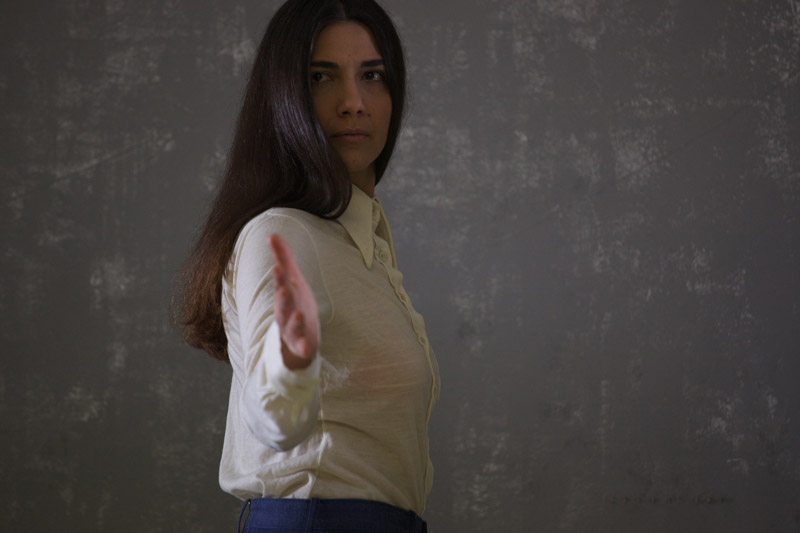
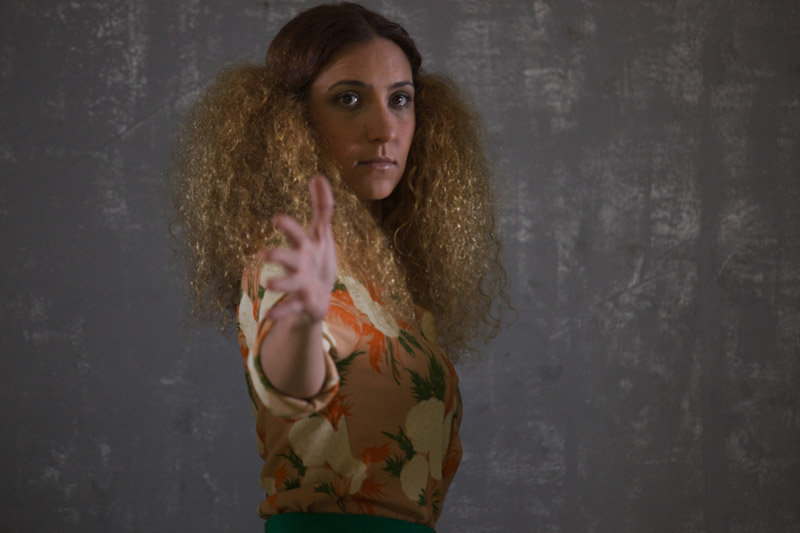
“Burn baby burn”, written by Carine Lacroix [Direction: Vasia Attarian]
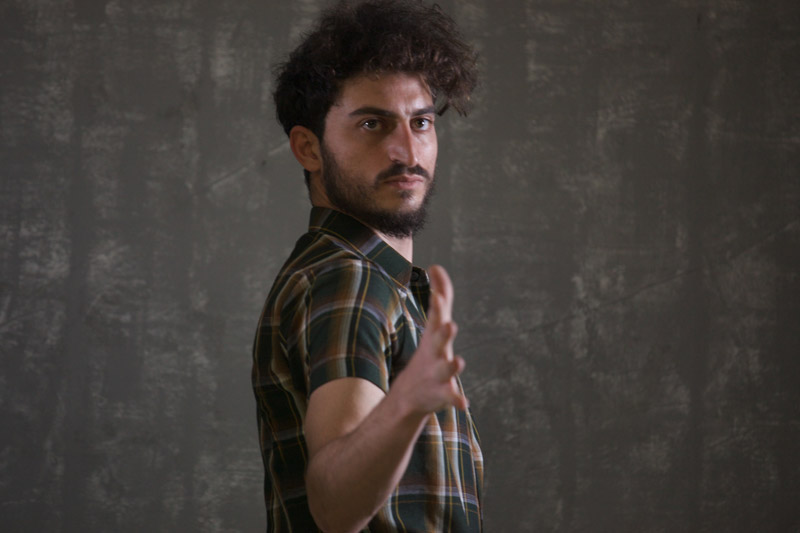
Note by: Vasia Attarian
The place.
The sum of the areas of the place/space with a common identity.
The environment which is inextricably linked to the idea of distance in three dimensions.
A place through which people, seasons and time pass.
Time.
The undefined motion of existence and events of the past, the present and the future, considered as one. Time and space, when united by the presence of one or more people, create memories.
The memory.
The place in which they are collected, stored and from which information is consciously and subconsciously obtained. Images, emotions, notions, aromas, sounds and flavours.
There is only one place. Timeless. Fleeting. Timeless.
A gas pump and a few cafeteria chairs. Once as pretty as they are now abandoned.
This is a place where two girls will meet and later a boy, a little before the coming of age, a little after adolescence. This is the place in which they shall meet and this is the place which shall define their evolution.
It probably doesnt matter whether Irip or Violet should come here, or perhaps someone else. Time rolls on without giving us much thought. Such places exist. They exist in Pikermi, in the South of France, in an abandoned amusement park with a wild west theme. In romantic movies in provincial America of the 90s, there in the background, in the wheat fields, there is always some evidence that life was once there. In bars and cafes which line the motorway of any old place. In Coen brothers movies , in which the hero always goes into a decadent café to buy cigarettes rarely to stay, in Wim Wenders Paris,Texas. Tarantinos second heroes always have such a hangout, Pierrot le Fou passes by such places and most likely eyes them with optimism
As in Waiting for Godot, the heroes await the savior or the great Other, and so here as well the heroes and even the place itself, are waiting. As two people will listen to one side of a disc for ten minutes and then change sides with reverence and continue to listen. As in a meeting between strangers in a local bar, where both are ready to admit that the evening is pointless, yet nobody makes a move to leave.
Escape is mentioned thousands of times and yet someone will always be ready to reject it. Basically, in order to escape, there must be some other place, a place in where you would really want to be. The coast seems like a trip to the moon. Some people have been, everybody knows about it. Paradise is always somewhere else.
Words lose their meaning when the atmosphere presides over them.
A road movie which was abruptly interrupted. The camera froze and the image is visible but doesnt move.
Note by: Dimitra Kondilaki, Theatre Theoretician, Director, Translator
Burn Baby Burn: Here is a contemporary French work which, even judging by the title, is striving to appear less French than expected. And so the actress Carine Lacroix (born 1974), the author of the work, suggests at a bizarre blend of narration and action, artistic mood and harsh realism which reminds us of a road movie. A peculiar and theatrical Thelma and Louise, which substitutes the racing speed of the cinema, the incessant chop and change of scene, the crazy pace of the trip for a poetic glorification of escape which is channeled as much into the plot as it is into the almost independent textual composition of the scenic guides which articulate it.
Here everything is static, nothing moves. We are not in motion, we are in quite the opposite, in stasis. A derelict gas station / rusted sign-posts, cracked walls, weeds everywhere / Forgotten amongst endless corn fields, on a road which no one follows / Chains, intertwined, melt upon the asphalt. It is from this scene of inertia and abandonment, which does nothing but project the inertia and abandonment in each of their lives, from which these adolescents wish to escape. However initially insensitive and hostile to one another, their chance meeting will offer them the opportunity to share their loneliness, their anger, their sadness at a life that is drowning them and will add fuel and fire to their fantasies of escape.
Up until the moment where reality rears its ugly head in the form of an unsuspecting young man, a lively soul, warm and sure of himself whose arrival shall spawn panic. Without wanting to, his very existence accentuates even more harshly the void of love. Now escape becomes a necessity rather than a fantasy. Now the two heroines are literally at the edge of the cliff and their only hope lies in one another.
A truly fascinating example of contemporary dramaturgical exploration thanks to scenes composed of poetic language as well as lively, hilarious dialogue which is sure to capture the Greek scene, as it did that of Europe, provided the direction maintains a distance from the stereotypical elements of the plot.
Carine Lacroix states that her life began when she was 10 years old, when her parents decided to abandon Paris for a year away from the routine, to travel across Europe in a caravan. In order to replace traditional schooling she would write, play outdoors, invent languages, visit archaeological sites and sleep outdoors. This was her defining year and greatly influenced her interests as concerned literature, travel and her innermost desires. After a decade in acting, she now dedicates all her time to writing; mostly plays. Burn Baby Burn is staged for the first time at the Comédie Française, the Deutsches Theatre of Berlin, in Prague and in Munich. It has been translated into many languages and obtained the Beaumarchais-SACD scholarship, the Days of the Writers Award, in Lyon. The play Le Torticolis de la girafe is being staged at the Rond-Point Theatre. She also writes for radio stations such as France culture and France Inter. Since 2010 she has organized, along with Moreau (Frédéric Mauvigniers pseudonym), readings in a bar, in the 10th arrondissement of Paris, called the Train de vie, inviting different writers once a month. Her last publication: the play Une fille sans personne to be staged at the Avant-scéne theatre.
Direction and supervision of the translation: Dimitra Kondylaki
Artistic supervisor: Vasilis Mavrogeorgiou
Direction: Vasia Attarian
Dramaturgy: Erifili Giannakopoulou
Set design-Costumes: Alexia Chrysohoidou
Movement director: Elena Gerodimou
Music supervision: the theatre company
Assistant directors: Erifili Giannakopoulou, Eirini Georgalaki
Performing: Promitheus Neratini-Dokimakis, Myrto Makridi, Ioanna Rabaouni
The voice of Vasilis Mavrogeorgiou is heard.
******
2nd Contemporary Theatre Festival
French Theatre à la Grecque
The French Institute of Athens – The Michael Cacoyannis Foundation
Theatre of speech, theatre of politics, theatre of memory, theatre of the soul.
The 2nd Contemporary Theatre Festival, French Theatre à la Grecque is here! The French Institute of Athens and the Michael Cacoyannis Foundation continue, for a second year running, in the organization of the event which was so warmly embraced by the theatre-loving public, this year presenting six new theatrical productions (one more than last year), using six contemporary French works, which have been especially translated into Greek and handed over to six talented Greek Directors of the younger generation, for their first presentation in this country.
Once again, contemporary French dramaturgy impresses with its richness, its controversial stance and its boldness. In the specially adapted underground area of the Michael Cacoyannis Foundation, from the 14th to the 31st of May 2015, artists of Greek theatre come face to face with works which are surprising and revealing and which talk of the void in love and the fantasy of escapism, the crisis-both social and economic -, domestic violence, homophobic discrimination, colonialism, power that is steeped in blood, and the values of theatre. Plays involving characters around the age of adolescence, who are always seeking an elsewhere paradise, or those who are older who, in either the half-light or the harsh light of the set, divulge inner secrets, guilt and dark pages of the story, in harsh dialogues heavy with humour, irony and cynicism.
With and without autobiographical hints, but most certainly with a multifaceted storyboard, the six works start up a dialogue between the past and the present; with the moral values and the torn public conscience, at the same time shedding light upon phenomena which constitute and very often define human temperament, as well as the people of today.
Six very different French writers: Carine Lacroix, with the work Burn baby burn, Simon Grangeat with T.I.N.A., Olivier Py with the work Théâtres, Pascal Rambert with Clôture de l’Amour, Enzo Cormann with Toujours lorage and Jean-Luc Lagarce with Juste la fin du monde, and six very different Greek directors: Vasia Attarian, Alexander Evkleidi, Louisa Costoula, K.Alexis Alatsis, Constantinos Hadjis and Enke Fezollari.
The works: Juste la fin du monde by Jean-Luc Lagarce, Toujours lorage by Enzo Cormann, Burn baby burn by Carine Lacroix, Clôture de l’Amour by Pascal Rambert, Théâtres by Olivier Py are available in print, in Greek from AGRA publications.
The programme of performances
14, 15, 16 may 2015, at 21:00
Burn Baby Burn
Carine Lacroix
Translation: Translation workshop of the French institute with the participation of: Simoni Athanasiou, Panagiotis Dry, Vicky Campouri and George Saramaskou. Direction and supervision of the translation: Dimitra Kondylaki
Direction: Vasia Attarian
17, 18, 19 May 2015, at 21:00
T.I.N.A., a short story about the crisis
Simon Grangeat
Translation: Effie Giannopoulou
Direction: Alexander Evkleidi
20, 21, 22 May 2015, at 21:00
Théâtres
Olivier Py
Translation: Maria Efstathiadi
Direction: Constantinos Hadjis
23, 24, 25 May 2015, at 21:00
Clôture de l’Amour
Pascal Rambert
Translation: Nicolitsa Aggelakopoulou
Direction: K. Alexis Alatsis
26, 27, 28 May 2015, at 21:00
Toujours lorage
Enzo Cormann
Translation: Maria Efstathiadi
Direction: Constantinos Hadjis
29, 30, 31 May 2015, at 21:00
Juste la fin du monde
Jean-Luc Lagarce
Translation: Andreas Staikos
Direction: Enke Fezollari
Performance photography: Aggelos Ballas
Photographs of the performance Toujours lorage: Georgia Leni, Aggelos Ballas
Photographs of the performance Juste la fin du monde: Venetia Venetiadi
Video: Michalis Roumpis (Direction), Andonis Kounellas (Director of photography), Aggelos Ballas (Editing)
A coproduction: The French Institute of Athens & The Michael Cacoyannis Foundation
In cooperation with: SACD & COPIE PRIVÉE
Information
2nd Contemporary Theatre Festival
French Theatre à la Grecque
The French Institute of Athens – The Michael Cacoyannis Foundation
Hall: specially adapted underground space
All performances commence at: 21:00
Ticket price: 10, general admission, per performance
