The Milk Train Doesnt Stop Here Anymore by Tennessee Williams, directed by Korais Damatis
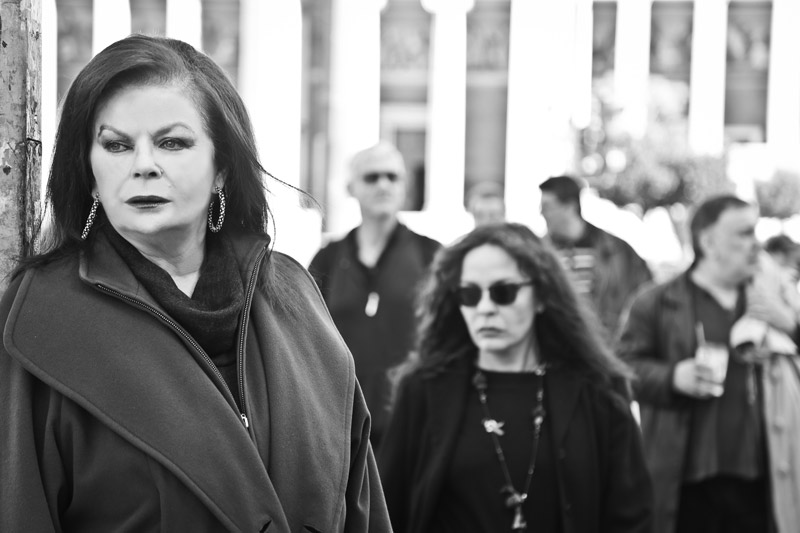
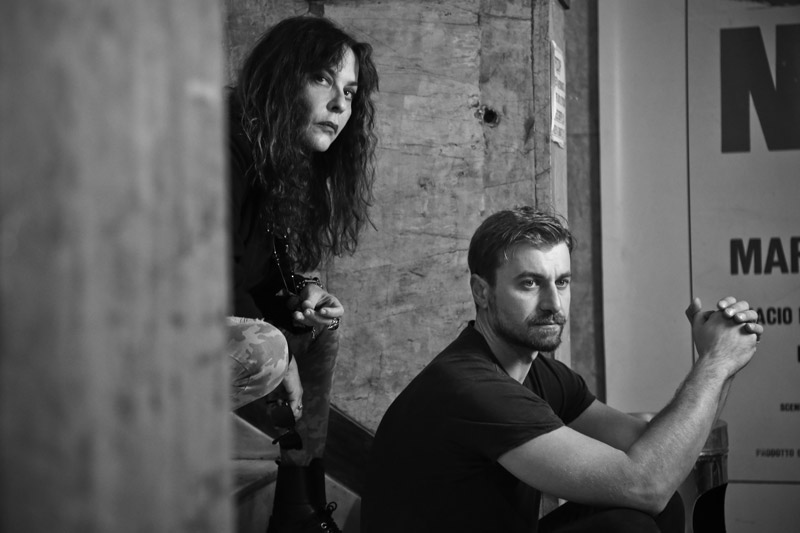

Flora Goforth, a rich elderly lady, patron of the arts only because she had once organized balls and receptions on the fringe of the art world lives isolated and ill in her retreat in Divina Costiera, in Italy, with her secretary, Blackie, who is ghostwriting her memoirs. She receives few visitors and only following a personal invitation made by herself. During this particular summer, however, she agrees to receive Chris Flanders, a not so young gigolo, who arrives at her home uninvited. Sarcastic and self-deprecating, difficult yet sensitive, and many times unforgiving and merciless, Mrs. Goforth tries to understand this enigmatic man, to comprehend his presence in her life. A meeting which bears all the signs of fate and unavoidable destiny.
One of Tennessee Williams last works, avant-garde in its timeliness as it broaches the subject of euthanasia. An international term which comes from the Greek works eu and thanatos. The calm and dignified death of a human being; today, by the term euthanasia we mean the painless, peaceful death offered to a suffering patient by the attending physician or relative or friend, humanely and with compassion towards a life swallowed up by pain and intense psychological anguish due to a terminal illness or a terrible accident with no hope of recovery. The meeting between the heroine and this mysterious man who arrives at her home from the very start provokes great interest and unanswered questions. What does this newcomer want? What is he looking for? What does he want to offer and what does he want to take? We watch with interest as the plot thickens and await the final outcome! Humorous dialogues the writer called this work a dramatic comedy twists, eroticism and an insatiable love for life. And so, did Chris Flanders come only to help Flora Goforth get to the other side, in this time in her life when the world is changing around her, becoming distant and murky? Will he be present through the mystery of the passing from life to death? Is the hero an ex-gigolo or a compassionate Angel of Death?
Death is one moment and life is so many of them!
A few words from the translator of the work, Errikos Belies:
Tennessee Williams wrote this play in 1959 and it was first staged at the Spoleto in Italy in 1962, whilst the first production in the States took place in New York in 1963. We have seen how the writer, in most of his plays, becomes engaged in a particular theme; the decline of the body and subsequently the life of his main characters. All of them (with the exception of Serafina in The Rose Tattoo) are shipwrecked souls searching for one final salvation raft, some with a sense of the impending end and others with the hope that that end will be late in coming. Williams is a master in the anatomy of the End, however in this particular work, he outdoes even himself.
His heroine, Sissy Goforth, is an elderly wealthy woman with a lively sexual past, who has arrived at her limits in body and soul. She will be visited by Chris Flanders who is living his last bursts of youth and who will assist her in the passage to her natural end as he has done with countless other wealthy ladies of a certain age who all died in his very arms. Chris is the Angel of Death as characterized, in an ostensibly charming manner, by one high standing gentleman in Goforths social circle. A professional escort for ladies, like Chance in the Sweet Bird of Youth and Paolo in the novel The Roman Spring of Mrs. Stone, Chris, like them, is an opportunist but he differs from them in that he offers these women the ultimate service, without partaking himself, simply as an assistant in the process, as a Hermes as psychopomp. In this play, as in most of the works by the American playwright, time is counted in moments and identified by the age of the flesh, and not as a metaphysical entity or an ontological concept: it is simply a part of existential anxiety and as such is inseparably bound to the personal happiness and success of each being. Williams time is American time, a time without a history and un-philosophised and as such desperately heartbreaking.
In most of the works by the author and playwright, a heavenly place faintly exists from where it is impossible to return since the heroines live a life without myth and without God, their only knowledge and compass their desire for carnal pleasure. In America, where life does not comply to puritanical law, what is moral is useful and what is useful is essential and the only value is that of buying power therefore time is experienced as rejection and the old have an expiry date and so are placed outside the game and outside time. The play is a variation on Williams obsession with the withdrawal of a person once the model becomes outdated as happens with machinery. If we add to that the usual characteristics bestowed by the writer upon his characters (the sexual male who invades the life of a woman and the woman who, with her repressed desires, accepts him) we have here a theatrical result which is somewhat reminiscent of eating dark chocolate: a little while after the initial pleasure, one is left with a bitter taste in the mouth of indefinable origin.
Errikos Belies
I dont want realism. I want magic. Yes, yes magic
I try to give that to people. I misrepresent things to them. I dont tell the truth, I tell what ought to be the truth. And if thats sinful, then let me be damned for it!
Life is all memory except for the one present moment that goes by you so quickly you hardly catch it going
Why did I write? Because I didnt find life satisfying enough
Death is one moment and life is so many of them
Hell is yourself and the only redemption is when a person puts himself aside to feel deeply for another person
The theatre is a place where one has time for the problems of people to whom one would show the door if they came to ones office looking for a job
Production Team
TRANSLATION: Errikos Belies
DIRECTION-LIGHTING: Korais Damatis
SET DESIGN: Giorgos Litzeris
COSTUMES: Anna Machairianaki
Stage Assistants: A: Kleanthis Varsamoulis
B: Constantinos Makridakis
Performing (in the sequence they appear on stage):
SISSY GOFORTH: Nora Katseli
BLACKIE: Vanna Pefani
CHRIS FLANDERS: Solonas Tsounis
CONNIE RIDGEWAY: Nefeli Orfanou
Information:
Thursday 21st of January until Sunday 21st of February 2016
Every Thursday, Friday & Saturday at 21:30
Every Sunday at 19:30
The Milk Train Doesnt Stop Here Anymore
by Tennessee Williams
Translation: Errikos Belies
Directed by: Korais Damatis
Performing: Nora Katseli, Vana Pefani, Solona Tsouni, Nefeli Orfanou
Hall: Specially adapted underground area
Duration: 80
Ticket price: 12, on Thursdays, Fridays & Saturdays 10, on Sundays
