

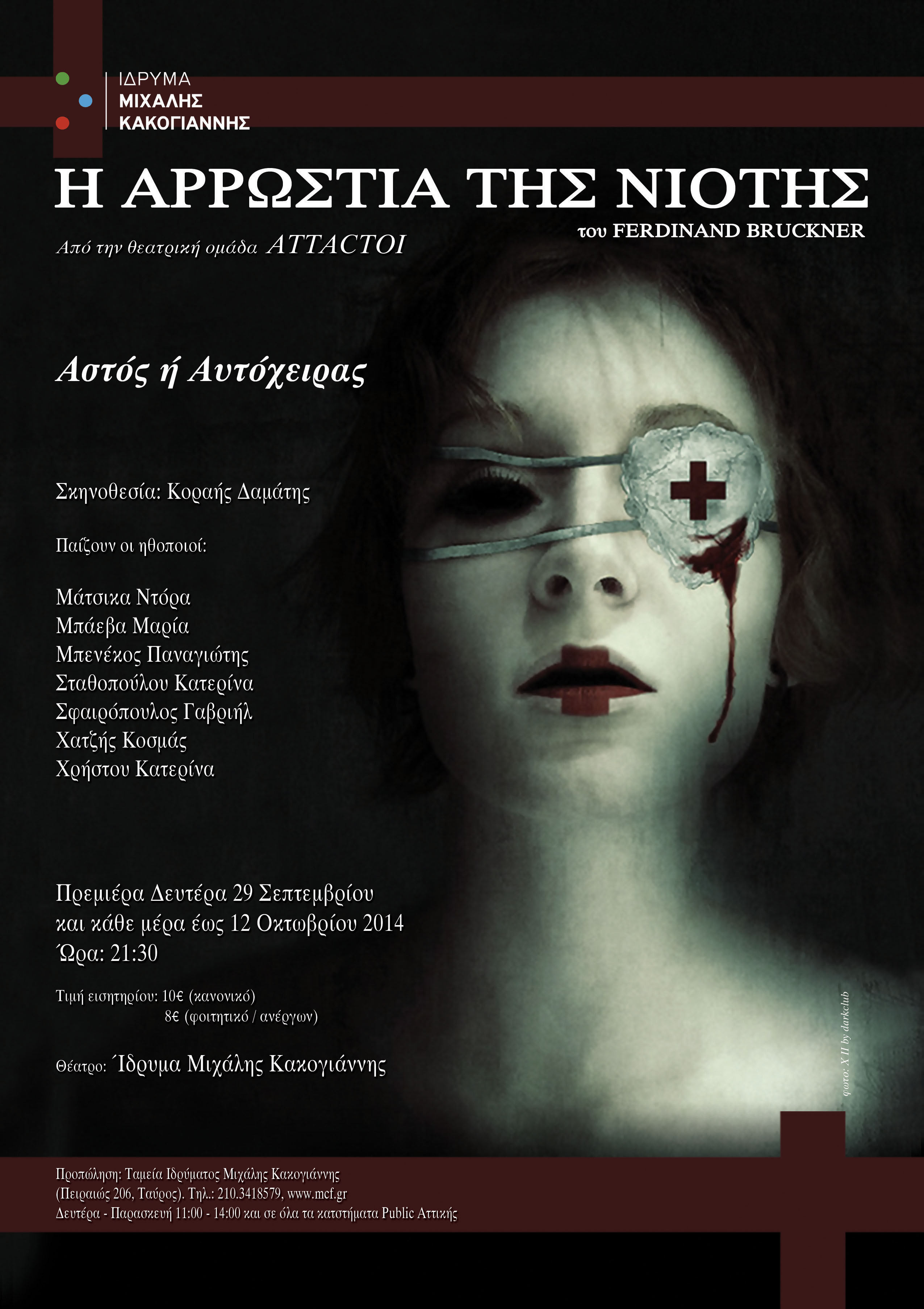
“Pains of Youth” by Ferdinand Bruckner – Directed by Corais Damatis
at 21:30 (daily)
“Pains of Youth”
by Ferdinand Bruckner
directed by Corais Damatis
by the theatre company Attactoi
“We become urbanized or we commit suicide. There is no other choice.”
1928 Germany
 We are in the meantime between debacle of the First World War and before the second one. The region of Germany-the democracy of Weimar – is in front of a dead end. The post-war humiliation has been taken sizes of national defeat, the lack of trust to politics and politicians, the uncertainty for the future, the hunger and abjection, a long – term misty future without salvation solutions, are creating slowly diseased social mire which begins to feed the nightmare of the National Socialism.
Ferdinand’s Bruckner Pains of Youth has first revived in Berlin on 1928 with great success. All characters are antiheroes. Between twenty and twenty five years old, ages in which personality takes the final form, with sexual experiences and sexual regressions irresolute to make position borders and choices, with questions and dilemmas for the decision of a career, the characters of the play are accepting with good grace their frail era, they are delighted with the social decay and with the lack of visions, they dont rebel, they are accepting their guilt without waiting a good sign, a hopeful light, nerveless from a deep exhaustion and carelessness for the problems around them.
 The colloquy is short-spoken and absolutely realistic with common language even when the writer fells in temptation of some psychoanalytical sentiments, to show the mental, stuffy disorder of his characters. Far over from the characters and their relationships the play is going deeper, into a detailed surgery, to point, show and finally warn of the massive size of social decay.
While avoiding the regardless illusions for easy cure and recover, he prefixes the return into a humanistic society or, if that is not possible- the time doesnt wait- into the birth of a new human with any changes this implies. Although this play was written under the given political circumstances and conflicts of an era, remains an alive and, unfortunately, an evergreen look of our era and our immediate needs.
