

2nd Silent Film Festival
In cooperation with STUDIO – Parallel Circuit,
and its President Christos Papadimitriou as well as the laboratory
Film Scoring with professor supervisor Alexandros Mouzas
The writer Stathis Sklavounakos presents every film with a short comment
The 2nd Silent Film Festival of Michael Cacoyannis Foundation will soon be a fact with the collaboration with STUDIO – parallel circuit and its president Christos Papadimitriou. The Festival comes afresh at the Open Air Terrace, at the 3rd and top floor, where an authentic summer cinema is being set up with the audiences entrance free of charge, in order to fulfill Michael Cacoyannis’, the President’s promise in the end of the previous, very successful tribute to American silent cinema, for European silent film screenings, which anyways include some of the “greatest” directors as well as movies of the global cinema of all times.
The films have been selected with special care by the director himself focusing on the undoubted aesthetics – artistic value as well as in regards to the best possible condition of the material that would be screened. Thereby he invites us to a fest where 16 films will be screened, filmed from 1917 to 1929, with their original soundtracks or in cases that do not exist with live music accompaniment by Greek artists, with Greek or English subtitles. Every film will be prefaced with a short comment by the writer of the popular book Vamps, Stathis Sklavounakos.
Among the films we will enjoy Battleship Potemkin by Sergei Mikhailovitch Eisenstein (1925) with the legendary six-minute scene at the stairs of the Odessa city in which Eisenstein tutors rhythm, austerity, plasticity and preciosity techniques, the futuristic Metropolis – the monumental science fiction film (1927) by Fritz Lang, Faust (1926), probably the best film ever made by F. W. Murnau, the masterpiece of Swedish Silent Cinema The Outlaw and his wife by Victor Sjostrom (1918). The first example of German expressionism in cinema The Cabinet of Dr Caligari – Robert Wiene (1919), the full of memorable images film The End of Saint Petersburg by Vsevolod Pudovkin (1927), the fanciful science fiction film Aelita – The revolt of the Robots by Yakov Protazanov (1924), the evoking film Michael by Carl Theodor Dreyer (1924), the A. Hitchcock’s film The Manxman (1929) and many more.
A compilation from the origins of the cinema art in Europe, which Proust has characterized as “the literature novelty” which still amaze us.
Plot synopsis
An elderly painter, Claude Zoret, adores the young pupil he has adopted first as a model and then as his son. Zoret watches helplessly as Mikaël drifts away from his exotic love into an affair with the even more exotic Princess Zamikoff. Driven to despair by the boy’s unconscious cruelty, he shuts himself away as a hermit, gives up his will to live, and dies after leaving everything he owns to Mikaël. (Excerpt from The Cinema of Carl Dreyer by Tom Milne, published 1971).
About the movie/ Michael
Michael, adapted from a novel of the same name by the Danish writer Herman Bang, is the story of a famous artist, called The Master, and his love for a young man, Michael, who is his model and protégé. The Master gets a commission to paint a portrait of the Countess Zamikow, but he can’t quite capture the expression in her eyes. Michael, however, can. He has fallen in love with her. Time and again Michael abuses The Masters trust in him, and The Master keeps forgiving him. Tortured by loneliness and Michael’s selfishness, The Master creates a final, magnificent painting before he dies, uttering the words, “Now I can die in peace, for I have seen a great love.” Michael is unable to free himself from the Countess’s embrace long enough to visit The Master on his deathbed.
This sophisticated film unfolds in sumptuously decorated interiors filled with extravagant objets d’art. Dreyer had a big budget and UFA’s state-of-the-art studio facilities at his disposal as well as Karl Freund, a top director of photography in his day. Michael is a chamber play, depicting a few people and their mutual relationships. All significant things remain unspoken. Dreyer has the camera tell the story in glances, facial expressions and objects. For Dreyer, working with the actors was what mattered, guiding them to give nuanced and precise emotional performances to be captured in close-ups.
The film was well received in both Denmark and Germany, where Dreyer’s fellow Danish director Benjamin Christensen, playing The Master, was singled out for special praise. Michael was not shown in France, however, and commercially this costly, prestigious production was probably not a hit. Although the homoerotic nature of the relationship between The Master and Michael is merely hinted at Dreyer perfectly capturing the tone of Bang’s novel , it was enough for the film to be sharply denunciated in the US. Still, Michael appears to have been Dreyer’s favourite among the films he made before The Passion of Joan of Arc.
Release: 1924
Country: Germany
Other titles: Michael (DE – original title), Mikaël (DK), Heart’s Desire (GB), Chained (US)
Category: Feature
Running time: 86 min
Technical data: 35 mm – 1,33:1 – b/w mute
Production Company: Decla-Bioscop
Censorship classification: Allowed for all
Based on: The novel “Mikaël” (1904) by Herman Bang.
CREDITS
Directed by: Carl Th. Dreyer – Director
Screenplay: Carl Th. Dreyer – Screenwriter
Produced by: Erich Pommer – Producer
Cinematography by: Karl Freund – Director of Photography
Production design: Hugo Häring – Art Direction
Cast
Benjamin Christensen: Claude Zoret, artist
Walter Slezak: Mikaël
Nora Gregor: Princess Zamikow
Alexander Murski: Mr. Adelsskjold
Grete Mosheim: Mrs. Adelsskjold
Robert Garrison: Schwitt
Didier Aslan: Duke de Monthieu
Karl Freund: Art dealer Leblanc
Wilhelmine Sandrock: Widow
Eugène de Klotz: Baron
Max Auzinger
Mady Christians
Summary
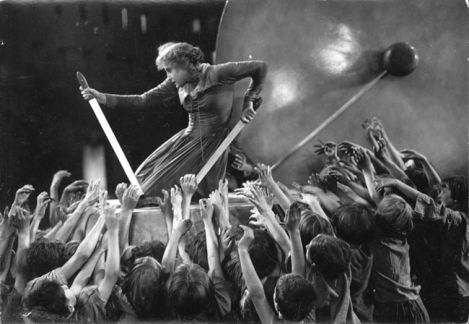
Metropolis takes place in the year 2026. Joh Fredersen rules over the huge city of Metropolis. He is referred to as the Master and has absolute control. The futuristic city of Metropolis is populated by a privileged class who live in luxury in spectacular, towering buildings that reach to the sky. Their lives of luxury and leisure are the result of the huge labour force who endlessly toils below the city, in the dark and impoverished underground. The needs of these workers are unimportant to Fredersen; he expects them to work gruelling ten-hour days without complaint or further expectation, all to fuel the machines and allow the elite their beautiful city of leisure. The son of Master Fredersen, Freder Fredersen, is frolicking in the Miracle of Eternal Gardens when, by mistake, he…..
Metropolis – the city of the future. Fritz Lang’s monumental science fiction film combines visual power with a love story around the reconciliation of labour and capital: Joh Fredersen rules the city from high above while the workers are non-stop plodding underground. Fredersen’s son Freder falls in love with Maria, the workers’ leader.
At the same time, Rotwang, the inventor, creates a steel robot and is instructed by Fredersen to model it after Maria. The fake Maria then instigates the workers who leave their machines and thus cause the flooding of the city. But Freder’s and Maria’s last-minute effort finally saves Metropolis from downfall. The ruler of the city and the workers realize that the “head” and the “hands” belong together.
Runtime: 124min
Year: 1927
CAST
Joh Fredersen: Alfred Abel
Freder Fredersen: Gustav Fröhlich
Maria / The Robot: Brigitte Helm
Rotwang: Rudolf Klein-Rogge
Josephat: Theodor Loos
Grot (Foreman): Heinrich George
Slim: Fritz Rasp
Master of Ceremonies: Heinrich Gotho
Georgi, 11811: Erwin Biswanger
Mafinus: Hans Leo Reich
Jan: Olaf Storm
CREW
Director: Fritz Lang
Screenplay: Fritz Lang & Thea von Harbou
Producer: Erich Pommer
Original Music Score: Gottfried Huppertz
Cinematography: Karl Freund & Günther Rittau
Art Direction: Otto Hunte, Erich Kettelhut & Karl Vollbrecht
Costume Design: Aenne Willkomm
Set Designer: Edgar G. Ulmer
Special Effects: Ernst Kunstmann
Visual Effects: Gunther Rittau & H.O. Schulze
Painted Effects & Technical Advisor: Erich Kettelhut
Sculptures & Robot Design: Walter Schultze-Mittendorf
Makeup: Otto Genath
Still Photography: Horst von Harbou
Production: Universum-Film AG (UFA), Berlin
Summary
Dr. Schoen, owner of a large newspaper, has fallen under the spell of the beautiful florist Lulu. Not concerned with what others may think, he marries Lulu. Shortly thereafter, Lulu can no longer stand him, shoots him and is prosecuted. She then flees to Paris with Schoen’s son Alwa and another friend. But soon Lulu falls into the hands of a blackmailer and Alwa becomes a cardsharp. Once again, Lulu has to escape; this time her goal is London, where she finally meets her fate. She becomes a prostitute and, on Christmas Eve, Jack the Ripper’s next victim.
Black & White / Germany
Duration: 131min
Year: 1929
CREDITS
Director: G. W. Pabst
Screenplay: Ladislaus Vajda
Cinematographer: Günther Krampf
Original music: Willy Schmidt – Gentner (1929)
Cast
Louise Brooks: Lulu
Fritz Kortner: Dr. Schön
Franz Lederer: Alva Schön
Carl Goetz: Schigolch
Krafft Raschig: Rodrigo Quast
Alice Roberte: Gräfin Geschwitz
Daisy d’Ora: Dr. Schöns Braut
Gustav Diessl: Jack the Ripper
Michael von Newlinski: Marquis Casti-Piani
Siegfried Arno: Inspizient
Production Company: Nero-Film AG (Berlin)
Producer: Seymour Nebenzahl
A masterpiece of the Swedish silent cinema, directed by Victor Sjöström. It is a film of remarkable psychological complexity, which bore a profound influence on the work of Ingmar Bergman and Carl Theodor Dreyer. Sjöström’s masterful use of landscape is visually and dramatically stunning, particularly in the film’s latter half, as the couplebattles both their pursuers and nature itself, culminating in an unforgettable climax. The film was groundbreaking for its portrayal of wild nature. It was shot in two sessions in the spring and late summer 1917, with Åre and Abisko in northern Sweden acting as the highlands of Iceland.
Synopsis
A man who calls himself Kári is offered a job by a wealthy widow named Halla. Eventually they fall in love, but one day in church a man recognizes Kári as his true identity – the escaped criminal Eyvind of the Hills. Eyvind has to flee to the highlands, and Halla decides to go with him. There they have a child and live happily in love, providing food by hunting and fishing, until one day when Eyvind’s old friend Arnas appears, also he an outlaw, and falls in love with Halla too. Other people are conspiring to get rid of the criminal as well, and the living conditions for Eyvind and Halla start to become worse and worse. Source: IMDb
Runtime: 73min
Year: 1918
CREDITS
Direction: Victor Sjöström
Production: Charles Magnusson
Screenplay: Victor Sjöström, Sam Ask
Starring: Victor Sjöström, Edith Erastoff
Cinematography: Julius Jaenzon
Synopsis
At New Year’s Eve, the tuberculous sister of the Salvation Army, Edit, asks her mother and her colleague, Maria, to call David Holm to visit her on her deathbed. Meanwhile, David (an alcoholic) is recounting the Legend of “The Phantom Coach and his coachmen” to two other drunkards in the cemetery. In accordance with the legend, the last sinner to die on the turn of the New Year becomes the soul collector, gathering souls in his coach. When David refuses to visit Edit, his friends have an argument with him, they fight and David dies. When the coachman arrives, he recognizes his friend Georges, who died at the end of the last year. George revisits parts of Davids obnoxious life and in flashbacks, he shows how mean and selfish David was.
Black and White/Swedish
Duration: 106 minutes
Year: 1921
CREDITS
Director: Victor Sjostrom
Production: Charles Magnusson
Screenplay: Selma Lagerlof, Victor Sjostrom
Cast: Victor Sjostrom, Hilda Borgström, Tore Svennberg, Astrid Holm, Concordia Selander
Synopsis
Jeanne, a young Parisian milliner, gives up her beloved Armand to start an affair with the nobleman Du Barry and begin a career as a courtesan. King Louis XV decides to take her as his mistress, but first she must have a title, so she marries the brother of Du Barry. As Madame Du Barry, Jeanne becomes the most powerful woman in France, but she is resented by the ordinary folk of Paris. Her greatest enemy is her jilted lover Armand, who has every intention of destroying her if he can. In the revolution of 1789, he has the opportunity to do just that…
Before he became world-famous for his sophisticated sex farces, Ernst Lubitsch was primarily a director of outsized German “spectaculars.” One such was Madame Du Barry, an operatic version of the life, loves and death of the legendary18th-century French courtesan. Pola Negri plays DuBarry, who sleeps her way to the court of King Louis XV (Emil Jannings), ultimately becoming his mistress. Comes the revolution, and the rabble demands DuBarry’s head. This gives Negri plenty of opportunity for strenuous histrionics as she’s led to the guillotine. Small wonder that this film was retitled Passion for its American release.
CREDITS
Genre: Historical / Drama
Director: Ernst Lubitsch
Script: Norbert Falk, Hanns Kräly
Cinematography: Theodor Sparkuhl, Kurt Waschneck
Cast: Pola Negri (Madame Du Barry), Emil Jannings (Louis XV), Harry Liedtke (Armand De Foix), Eduard von Winterstein (Count Jean Dubarry), Reinhold Schünzel (Choiseul), Else Berna (Graefin Gramont), Fred Immler (Richelieu), Gustav Czimeg (Aiguillon), Karl Platen (Guillaume Dubarry), Magnus Stifter (Don Diego), Paul Biensfeldt (Lebel), Willy Kaiser-Heyl (Oberst der Wache), Alexander Ekert (Paillet)
Country: Germany
Language: German
Runtime: 114 min, B&W, silent
Battleship Potemkin by Sergei Mikhailovitch Eisenstein (1925)
After the success of Strike (1924), Sergei Eisenstein was commissioned by the Soviet government to make a film commemorating the uprising of 1905. Eisenstein’s scenario, boiled down from what was to have been a multipart epic of the occasion, focussed on the crew of the battleship Potemkin. Fed up with the extreme cruelties of their officers and their maggot-ridden meat rations, the sailors stage a violent mutiny. This, in turn, sparks an abortive citizens’ revolt against the Czarist regime. The film’s centerpiece is staged on the Odessa Steps, where in 1905 the Czar’s Cossacks methodically shot down rioters and innocent bystanders alike. To Eisenstein, this single bloody incident was the crucible of the successful 1917 Bolshevik revolution, and the result was the “Odessa Steps sequence,” which is often considered the most famous sequence ever filmed; it is certainly one of the most imitated, perhaps most overtly by Brian De Palma in The Untouchables (1987). This triumph of Eisenstein’s “rhythmic editing” technique occurs in the middle of film, not as the climax, as more current film structure might do it. All the actors in the film were amateurs, selected by Eisenstein because of their “rightness” as types for their roles. Pictorial quality varies from print to print, but even in a duped-down version, Battleship Potemkin is must-see cinema.
Year: 1925
Runtime: 73 minutes
Cast
Alexander Antonov – Vokulinchuk
Vladimir Barsky – The Capt.
Grigory Alexandrov – Senior Officer Gilyarousky
Mikhail Gomorov – Sailor Motyushenko
Marusov – Officer
I. Bobrov – Recruit
Repnikova – zhenshchina na lestnitse
Alexandr Levshin
Andrei Fayt
Korobei – Legless Veteran
Levchenko – Boatswain
M. Brodsky – Intellectual
Citizens of Odessa – Themselves
A. Fait
Konstantin Feldman – Student Feldman
A. Glauberman – Abo
N. Poltautseva – School Teacher
Prokopenko – Mother of Wounded Aba
Members of the Proletcult Theatre
Protopopov – Old Man
Sailors of the Red Navy – Themselves
Beatrice Vitoldi – Mother With Baby Carriage
Zerenin – Student
Sergei Eisenstein – Priest
Production Members
Sergei Eisenstein – Director, Editor
Edmund Meisel – Composer (Music Score)
Eduard K. Tissé – Cinematographer
Nina Agadzhanova Shutko – Screenwriter
V. Popov – Cinematographer
Vasili Rakhals – Production Designer
A cinematic folktale, directed by Alexander Medvedkin, which satirizes the effect on the peasantry of pre- and post-revolutionary Russia. The film was almost entirely unknown in the West until it was resurrected by the French post 1968. Stalin banned the film for 40 years as anti-Bolshevik.
Regarding his film, Medvedkin has stated: the peasant himself – and this is just not true of our country, it’s part of the social psychology of mankind in all civilized nations – dreams of ownership. He wants a prosperous life to set himself apart from his thousands and millions of neighbors; he wants to creep ahead and have his own barn, his own horses, his own grain. In short he wants to be his own boss. Of course, for every 1,000, only one will manage it; the other 999 will remain farm-hands and starve, but this dream lives on among the peasants. So happiness is a satirical picture. I made it as the nail in the coffin of this rosy dream. I ridiculed that dream because it’s unrealistic; 999 people out of 1,000 get nothing from a dream like that.
Medvedkin was one of the masterminds behind the infamous Cine Train in Bolshevik Russia, whose underlying purpose was to document the plight of the peasantry and working class and present it to them as a mirror, thus enabling them to recognize their situation and, possibly, to change their lives.
Duration: 64 minutes
Year: 1934
CREDITS
Directed by: Alexander Medvedkine, Aleksandr Medvedkin
Written by: Aleksandr Medvedkin
Starring: Pyotr Zinovyev, Yelena Yegorova, Nikolai Cherkasov, Viktor Kulakov
While not as well known today as Nosferatu or The Last Laugh, Faust is perhaps director F.W. Murnau’s masterpiece; few films by any director can match it for the sweeping impact and beauty of its visuals or the power of its storytelling. Murnau approaches Goethe’s tragedy of a man who learns all too well the price of his soul with appropriately broad dramatic strokes, and if the effect seems a bit over the top in the early reels, it hits with full melodramatic force at the end; the full, horrible impact of Faust’s comeuppance is as disturbing today as it was in 1926. Gosta Ekman is fine as the luckless Faust and Emil Jannings is brilliant as Mephisto, the embodiment of cunning and evil. And the camerawork by Carl Hoffman and production design by Robert Herlith and Walter Rohrig are nothing short of astounding, creating a brilliantly controlled and beautifully painterly visual sense that’s the ideal backdrop for this fable. Anyone who thinks of silent films as sluggish and amateurish has obviously never seen Faust.
Black&White / Germany
Duration: 90min
Year: 1926
CREDITS
Direction: F.W. Murnau
Production: Erich Pommer
Written by: Hans Kyser
Starring: Gosta Ekman, Emil Jannings, Camilla Horn, Wilhelm Dieterle
Frida Richard, Yvette Guilbert
Music by: William Axt
Cinematography: Carl Hoffman
Aelita: Queen of Mars – The revolt of the Robots by Yakov Protazanov (1924)
The Marxist struggle reaches outer space in this fanciful Russian science fiction film from the silent period. Los (Nikolai Tsereteli) is an engineer who dreams of travelling to other worlds and imagines that a beautiful woman named Aelita (Yuliya Solntseva) lives on the planet Mars. Frustrated with the petty political conflicts that are a big part of life on Earth, Los builds a spaceship and travels to Mars, where he discovers that the lovely Aelita really does exist and is Queen of the Planet. However, the realities of political struggle do not escape him; it seems that the Martian proletariat are attempting to rise up and take power just as the Russian rank and file did, and Los once again finds himself standing between the ruling leadership and the workers attempting to take control of their own lives.
Genre: Action, Drama, Fantasy, Science Fiction
Runtime: 81 minutes
Year: 1924
Director: Yakov Protazanov
Screenplay: Aleksei Fajko, Fyodor Otsep, Aleksei Tolstoy
Cast
Yuliya Solntseva: Aelita, Queen of Mars
Igor Ilyinsky: Kravtsov
Nikolai Tsereteli: Engineer Los / Spiridinov
Nikolai Batalov: Gusev, Red Army Soldier
Vera Orlova: Nurse Masha
Valentina Kuindzhi: Natasha, Los’ Wife (as Vera Kuindzhi)
Pavel Pol: Viktor Ehrlich, Sugar Profiteer
Konstantin Eggert: Tuskub, Ruler of Mars
Yuri Zavadsky: Gol, Radiant Energy Tower Guardian
Aleksandra Peregonets: Ihoshka, Aelita’s Maidservant
Sofya Levitina
Varvara Massalitinova
Mikhail Zharov
Tamara Adelheim
Iosif Tolchanov: Mars Astronomer with Ihoshka
Vladimir Uralsky
N. Tretyakova: Yelena, Ehrlich’s Wife
Mother might rightfully be labelled Soviet propaganda. It is the story of a poor working-class woman at the time of the 1905 Revolution who, through her relationship with her worker son, becomes politicized. At first, she is oppressed, just another anonymous pawn of the power structure; at the finale she is exultant, a heroine and a martyr. However, the film is no boring treatise on the wonders of revolutionary spirit. Mother is a drama of love and conflict that can be universally understood and appreciated. In the scenario, based on a Maxim Gorky novel, a traditional theme, a mother’s concern for her beloved sonmay be stretched to fit into a propagandistic framework. But this fact does not obscure the heart-wrenching storyline and superior cinematic techniques of its maker, Vsevolod Illareonovitch Pudovkin.
Year: 1926
Runtime: 87 minutes
Directed by: Vsevolod Pudovkin
Produced by: Fred Orain, André Paulvé
Screenplay by: Maxim Gorky, Nathan Zarkhi
Cinematography: Anatoli Golovnya
Music by: Tikhon Khrennikov
Country: Soviet Union
Genre: Black-and-white, Silent film, Drama
In a film designed to commemorate the 10th anniversary of the 1917 Bolshevik Revolution, V.I. Pudovkin again portrays the dawning of political awareness. The End of St. Petersburg stars as a young peasant working a moribund farm. When his wife dies in childbirth in 1914, the young man heads for St. Petersburg, hoping to get help from his cousin (Aleksandr Chistykov), a factory worker. He’s stunned by the pace of the city and awed by the mountainous buildings. His cousin is too preoccupied with the strike he’s leading to be of any help to the lad, and the man’s wife (Vera Baranovskaya) suggests he should return whence he came. The farmer unwittingly joins a group of strike breakers and naively tells the factory manager that the strikers he’s curious about have been meeting at his cousin’s house. Deaf to his attempts at atonement, his cousin’s wife angrily tosses him into the street. Seeking revenge against the factory manager, the young man rolls through his office like a malefic tsunami before the police take him away. His education has begun.
The second of Pudovkin’s troika of 1920s masterworks, this film might be more incisive as an antiwar film than as a call to revolution, evincing the director’s recent combat experience. In a film full of unforgettable images, the cross-cutting of the jingoistic cries to arms with the frantic speculation of the war profiteers is a sequence of genius.
Duration: 68 minutes
Year: 1927
CREDITS
Director: Vsevolod Pudovkin
Editor: Alexander Dovzhenko
Cinematographer: Anatoli Golovnya
Songwriter: Herbert Stothart
Art Director: Sergei Kozlovsky
Cast: Alexander Christiakov, Vera Baranovskaya, Ivan Chuvelev, V. Obolenski, A. Gromov, Vsevolod Pudovkin
In this romantic melodrama, Hitchcock analyses the story of a fisherman, Pete and a lawyer, Philip. Best friends since childhood they grow up together on the island Man. They fall in love with the same woman, beautiful Kate. When Kates father refuses to allow Pete marry his daughter, he embarks for a journey in the sea looking for his destiny. He leaves his beloved girlfriend behind and asks his best friend to take care of her. When his track is lost and he is mentioned as a missing person Philip and Kate start off a relationship. However Pete comes back he gets married with Kate and they have a child. However Kate has to reveal who the childs father is. This fascinating story was the last silent film by Hitchcock.
Runtime: 118 minutes
Year: 1929
Genre: Romance Silent
Director: Alfred Hitchcock
Writers: Hall Caine (novel), Eliot Stannard
Director of Photography: Jack Cox
Editing: Emile de Ruelle
Artistic Supervisor: C. Wilfred Arnold
Cast: Carl Brisson, Malcolm Keen, Anny Ondra, Randle Ayrton, Clare Greet
