The Documentary as an Educational tool and more!
Whom is the Film Workshop aimed at
The Workshop is aimed at energetic teachers of all levels who want to equip themselves with knowledge and methods which will be useful in their work, at historical researchers, those studying verbal narration, storytellers and narrators, and people with general interests who wish to get to know the world of contemporary documentaries as well as people of the cinema world (creators, technicians and actors) who are looking to broaden their knowledge and experiences.
Former professional experience in field of cinema and audiovisual art is NOT REQUIRED.
What IS REQUIRED is a love of cinema, patience and curiosity: the basic ingredients needed in order to create cinema or to simply follow films with a creative eye.
What is the Workshop about
Documentaries are perhaps the most up-and-coming form of cinema in the world and in the past few years have flourished in Greece as well. Compared to the past, they now have a much greater range of subjects and variations in form, with more emotion and more humor. The contemporary documentary reaches out and aims to discover those unchartered territories of human consciousness, of society and of history.
It is through all these characteristics that documentaries have become a part of the Educational System, as most schools and foundations include them in their curricula as a multifunctional educational tool. Documentaries are enjoyed by children, they are useful for analysis and exercises and they can even instigate fresh cinematic efforts, by the children themselves.
The questions which will be discussed during the Workshop will make up three groups.
1. Use of documentaries in Education
– How can a documentary, and in particular those which are people-focused, become a valuable tool in the classroom?
– Apart from the basic subject of the documentary, how can we identify and utilize the multiplex knowledge and information offered via its images and narration?
– The value of narration in the visual and electronic age. Why is it important for children to learn to listen to and follow experiential stories?
– How important is it to learn to watch a film not only on the basis of what is said during the film but also from what is NOT said in words, i.e. through silence and body language, and through film language and cinematic narration?
The questions posed are not strictly school related: within them lie deep and fundamental truths which concern everyone and not just those involved in education.
2. Verbal testimony and Narration
– How do we record an honest and deep experiential account? What are the secrets of this art? The differences between the informants and the characters, between information and the sharing of the experience.
– How do we ultimately record testimony, narration and fairytales in a way that is lively, direct, appealing and contemporary and not just in order to
preserve the memory or the tradition?
– How much does the presence of the camera influence the everyday person who has been called upon to share their experience whilst being recorded and what can be done in order for the person to be able to regain that internal tension and the freshness of the first take.
– The ethics of documented verbal testimony, the insistence of the researcher and the resistance of the subject, the chemistry between them. The dilemmas and ethics of the editing.
3. The relationship between a short, personal story and a general story
– How can we see and teach the greater concept via the smaller stories delivered through the personal experiences of every-day people involved in some way with the subject.
– How is a documentary born within us as a film which looks back at history, with characters and times of the past, that which we call a history documentary?
– How can an entire documentary film be born of just one photograph or document?
– The multiple importance of cinematic archive material (topical etc): the magic of the past, capturing a lost world but also the questioning of the objectivity of the archival material. The point of view of the film-maker. Objectivism, subjectivism and deception.
The use, as examples, of two of my films – Filia eis ta Paidia (Kisses to the children) and Synandiseis me ti mitera mou Lela Karagianni (Lela Karagianni, Fragrance of a Heroine) – which have been used in all levels of Education, are revealing as concerns the above questions.
All these subjects which concern not only the art of recording testimony / narration but also how to approach the editing of the recorded material, make up the sum of this Workshop.
With screenings, analyses and examples we shall attempt to unfold the many layers of this subject.
Methods, Goals and Exercises of the Workshop
– An introduction to, or a reviewing, of some of the most recent Greek documentaries which will be analyzed using the above mentioned perspectives.
My documentaries in their entirety or as excerpts, Filia eis ta paidia (Kisses to the children) / Thileia (The Noose) / Synandiseis me th mitera mou Lela Karagianni (Lela Karagianni, Frangrance of a Heroine)/ Perasa ki ego apo kei ki eixa papoutsia apo charti (And I also passed by there and had paper shoes to wear)/ Mikres istories sth dini tis Istorias (Short stories from Turbulent Historical Times) as well as other works of great Greek directors, will be shown.
– The content of the above mentioned works will be approached methodically and in depth, thus instigating personal research, study and practice. This is something particularly useful for teachers, as it allows them to prepare for creative work in the classroom.
– Greater exposure to the language of film and especially its NON verbal elements, i.e. body language, the use of silence, the use of sound and music, the importance of the different frame sizes etc.
– We will go over the codes of narrating a story via image, taking part in experiential group exercises of audiovisual training, such as:
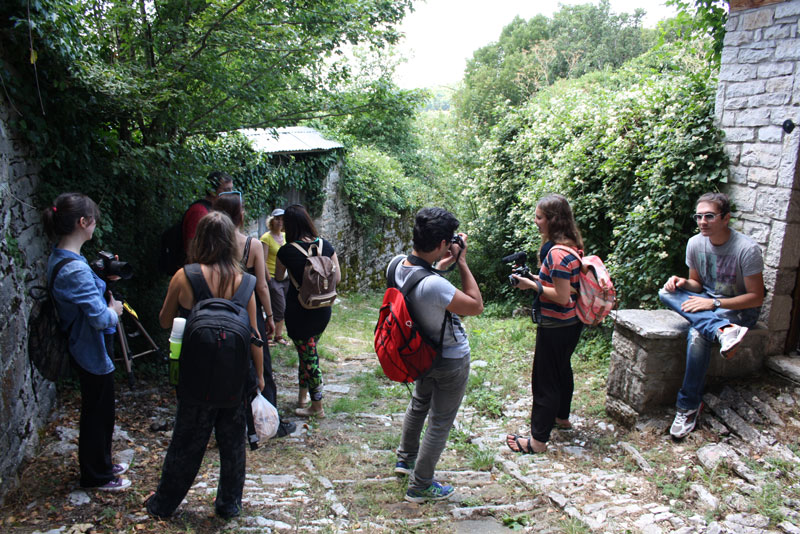
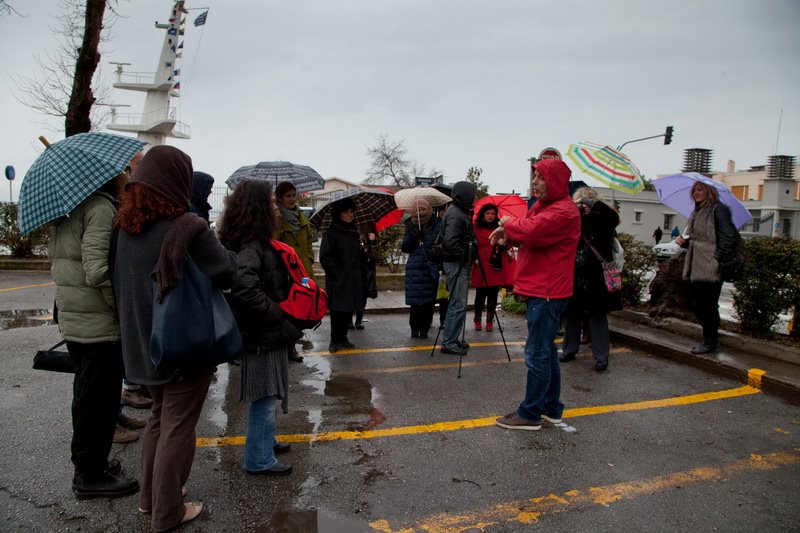
a) Re-photographing the set of an old, historic photograph in the exact same place today.
b) The development of an idea for a history documentary. Research.
c)An exercise which aims at familiarizing the participants with the various codes of perception and capturing of one same object. A photographic camera will be used. (This exercise was developed by the KARPOS group www.karposontheweb.org)
d) An exercise in which one of the participants films the personal recounts of volunteers. The aim being to discover how one can create an interesting and solid account out of an indifferent testimony of events. A video camera will be used.
We must not forget that we are making cinema: we are seeing and creating stories with image and sound!!! The above exercises are great fun to carry out and can be used by those who hold teaching positions with their own students in the classroom.
– Finally we shall learn or recap on the basic technical elements involved in the use of the camera, microphone etc.
What the workshop aims to achieve
– Although during the workshop there will not be the required time for the participants to actually create a film, our aim is to, ultimately, having imparted the necessary knowledge, assist the participants in being able to record stories from their own personal environments or use this knowledge in the classroom, in their own research or their own films.
Prerequisites which will help maximize your experience during the Workshop
In order for you to fully benefit from the Workshop, it would be a good idea if those who are interested in taking part do the following:
a) Carefully study this analytical information sheet.
b) Familiarize yourself with the methods of approach which will be adopted during the Workshop by following the links for the films in the attached BIOGRAPHICAL NOTES.
c) Study the attached text entitled COMMENT FOR THE DOCUMENTARY Synandiseis me th mhtera mou Lela Karagianni (Lela Karagianni, Fragrance of a Heroine).
d) Have with you a laptop, photographic camera and video camera (if you possess one) along with all necessary peripheral devices (batteries, cables, cards, adaptors etc) for charging and for uploading and downloading from the computer.
More information can be found in the two following attachments:
– BIOGRAPHICAL NOTES and SAMPLES OF WORKS BY V. LOULES
– COMMENT FOR THE DOCUMENTARY LELA KARAGIANNI
GENERAL INFORMATION – WORKSHOP STRUCTURE
Duration: 34 hours
(4 day cycle of theory, screenings and exercises)
Saturday 3rd Sunday 4th October 2015
Saturday 10th Sunday 11th October 2015
10:00 17:30
Maximum number of participants: 30
A Certificate of Attendance will be given
Participation fee: 80 for the full four day cycle
Closing date for applications: Friday 25th September 2015
By the above date the entire participation cost must have been paid into the designated account*
*The Participation fee should be deposited in the following EUROBANK account:
Account number: 0026.0101.56.0200749408
IBAN: GR3502601010000560200749408
Beneficiary: MICHAEL CACOYANNIS FOUNDATION
Please be sure to fill in the exact name of the participant on the bank deposit slip.
Information- Applications for participation: Vassilis Loules
vassilisloules@gmail.com
In order to apply please send the completed **Participation Form with the following details: full name, contact details (landline and mobile number, email), profession to Vassilis Loules email (vassilisloules@gmail.com).
Please also fill in a few lines in the Thoughts space to let us know your own personal reasons for wanting to attend the Workshop and what you hope to gain from the experience.
